Heritage
Camel Trophy history: the Defender’s proving ground
Two decades of mud, winches and sand-yellow paint turned a cigarette-brand promotion into the most famous off-road event ever staged, and made the Land Rover a legend in the process.
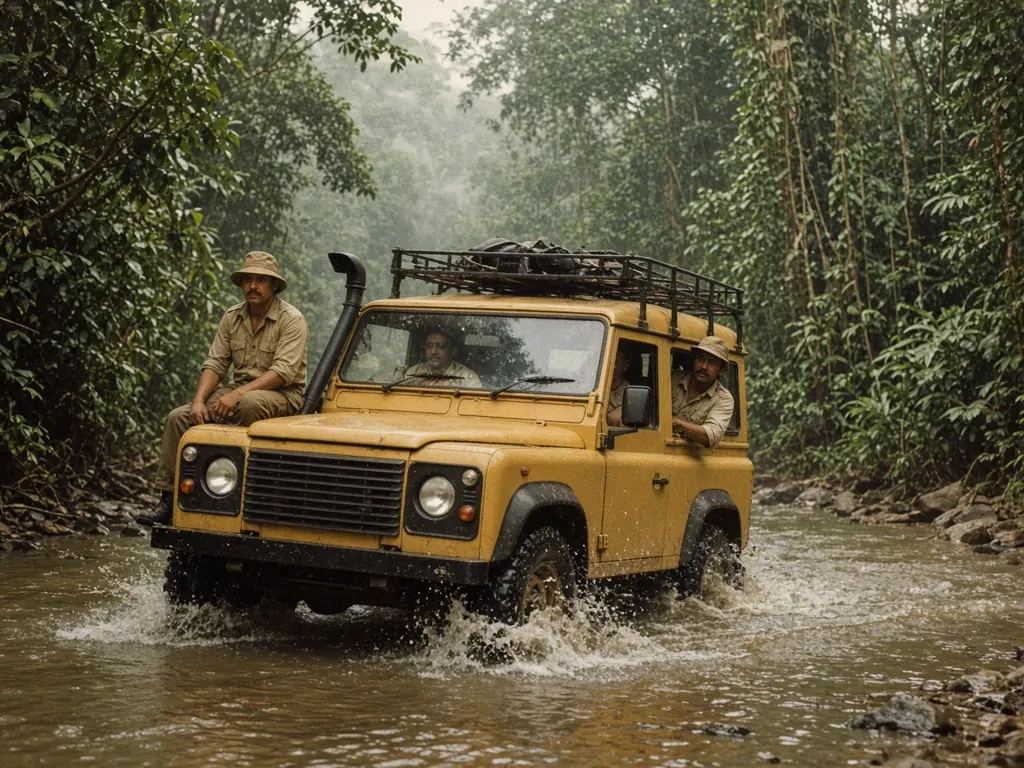
For roughly twenty years, a sponsored adventure competition known as the Camel Trophy sent teams of amateur drivers into some of the most difficult terrain on earth. It was a promotion for a tobacco brand, and it was also something more: a rolling, televised demonstration of what a well-prepared four-wheel drive could survive. The vehicles were almost always Land Rovers, painted a distinctive sand yellow, and the images of them buried to the axles in jungle mud did more to shape the public idea of the Land Rover than any advertising campaign could have. This is a short, factual history of the event, and of why it still matters to Defender owners today.
How the Camel Trophy began
The first event ran in 1980 along the Transamazonica highway in Brazil, with a small number of German teams driving Jeeps. It was modest by later standards, but the formula was already visible: ordinary people selected from a large applicant pool, an exotic and punishing route, and a camera crew to record every winch pull and river crossing.
From 1981 the organisers turned to Land Rover, and the partnership lasted until the end of the 1990s. Over those years the event used most of the company’s range as it evolved: the Range Rover, the Series III, the coil-sprung One Ten and Ninety that would soon be named Defender, the Discovery from 1990 onward and, at the very end, the Freelander. The Defender family served both as competition vehicles in some years and, very often, as the support and media vehicles that carried spares, fuel and film crews behind the convoy.
What competitors actually did
A Camel Trophy was not a race in the motorsport sense. Teams of two, usually representing a country, drove a set route over several weeks. Distance mattered less than progress: getting every vehicle in the convoy through a swamp, over a collapsed bridge or up a mud slope was the daily work. Much of the time was spent outside the vehicle, rigging winches, cutting tracks, building log bridges and pushing.
Points came from “special tasks”, timed challenges set along the way that tested driving precision, navigation, physical fitness and problem solving. Separate from the overall result, a Team Spirit award recognised the crew that did the most to help others. Many former participants say this award reflected the real character of the event better than the final standings.
Selection was famously demanding. National trials put applicants through driving tests, fitness assessments, first aid, mechanical knowledge and team exercises, and only a handful from each country made it to the event itself. For many of those chosen, it was the adventure of a lifetime.
Where it went
The list of host regions reads like an atlas of difficult places. Over the 1980s and 1990s the event visited, among others, Sumatra, Papua New Guinea, Zaire, Borneo, Madagascar, Sulawesi, the Amazon basin, Siberia, Tanzania and Burundi, Guyana, Malaysia’s Sabah region, Central America’s Mayan region, Kalimantan, Mongolia and Tierra del Fuego. Routes were chosen for their difficulty and their visual drama, and conditions ranged from equatorial rainforest to frozen steppe.
That variety made the event a remarkable field test. A vehicle that had been tuned for Europe was suddenly dealing with constant immersion, extreme heat, deep cold and loads far beyond normal use. Land Rover engineers and suppliers learned a great deal about what failed and why.
How the vehicles were prepared
The competition vehicles were close to production specification mechanically, but heavily equipped for the job. Photographs from the period show a consistent pattern of preparation that still influences expedition builds today:
- Recovery equipment first. A front-mounted winch, often a second recovery point at the rear, sand ladders, high-lift jacks and long lengths of strap and rope.
- Roof racks loaded with essentials. Fuel and water cans, spare wheels, tools and recovery gear, which raised the centre of gravity and demanded careful driving.
- Raised air intakes. Snorkels allowed deep wading through rivers and flooded tracks.
- Protection. Steering guards, sump guards, light guards and reinforced bumpers kept vulnerable parts intact.
- Auxiliary lighting. Roof-mounted lamps for work after dark, which in practice meant most evenings.
- The paint. The sand-yellow finish, known among enthusiasts as Sandglow, made the vehicles instantly recognisable on film and in the dense green of a rainforest.
The look, a yellow Land Rover with a black roof rack, a snorkel and a winch, became shorthand for adventure. It is still the most imitated colour scheme in the classic Land Rover world.
The Camel Trophy did not prove that a Land Rover could not get stuck. It proved that a well-equipped crew could always get it moving again.
Why the Defender became the symbol
Strictly speaking, the Defender name did not exist for the first half of the Camel Trophy years. The coil-sprung One Ten arrived in 1983 and the Ninety in 1984, and the range took the Defender name around 1990. But the shape was constant, and that silhouette appeared in almost every year of coverage, whether as a competition vehicle or as part of the support convoy.
Several qualities made the Defender ideal for this work. Its separate box-section chassis tolerated abuse and could be repaired in the field. Its aluminium body panels resisted corrosion and could be bent back into shape. Its long-travel coil suspension kept wheels on the ground in deeply rutted terrain, while permanent four-wheel drive with a lockable centre differential and a low-range transfer box gave it the traction to climb. And because it was mechanically simple, the people driving it could fix it.
The event also exposed weaknesses: drivetrain components that failed under repeated winching and shock loads, electrical connections that did not like constant water, and cooling systems pushed hard in tropical heat. Owners today benefit from decades of solutions that grew out of this kind of use.
The end of the event
As the 1990s closed, tobacco advertising faced growing restrictions in many countries, and public attitudes towards driving through fragile environments were changing. The later events placed more emphasis on adventure activities and environmental work. Land Rover’s involvement ended after the 1998 event in Tierra del Fuego, and the final Camel Trophy in 2000 was held in the South Pacific using boats rather than four-wheel drives. The brand name later appeared on clothing and accessories, but the expedition itself was over.
The legacy for Defender owners
Original Camel Trophy vehicles are now highly prized, and genuine examples with documented history command serious money. That has created a market for replicas and tribute builds. If you are looking at a vehicle described as an original, ask for documentation and expect specialists to check chassis numbers against known records. Many perfectly honest “Camel-style” builds exist, and there is nothing wrong with owning one as long as it is described accurately.
For owners who simply admire the look, recreating the spirit of the period is easy and respectful: a sand-coloured finish, a black roof rack, a snorkel, a winch and simple round auxiliary lamps. Avoid reproducing logos or event branding, which remain trademarks of their owners. And if you want to prepare a Defender for the kind of terrain those convoys crossed, start with the fundamentals the event taught: sound suspension, reliable recovery equipment, protected vital parts and a chassis free of rot.
Our guides on Defender suspension upgrades and Defender rust inspection cover those fundamentals in detail, and our comparison of the 300Tdi, Td5 and Puma engines will help you choose the right era of Defender to build on. To find period-style equipment, browse Defender parts or send us a custom request.
Related