Buying guide
Land Cruiser accessories: a buying guide for the 70, 80 and 100 Series
The Land Cruiser is already overbuilt. The trick to accessorising one is adding capability without adding so much weight that you undo Toyota’s work.
Disclosure: this article contains affiliate links. If you buy through them, The Reserve Collection may earn a commission at no extra cost to you. It never changes what we recommend. Read our full disclosure.

Few vehicles reward thoughtful accessorising like a Toyota Land Cruiser. The 70, 80 and 100 Series are already among the most durable four-wheel drives ever made, which means the best upgrades are not about fixing weaknesses so much as tailoring a very capable vehicle to the way you travel. The worst upgrades simply add weight. This guide explains which Land Cruiser accessories are worth buying, in what order, and how the right choice differs between the three generations.
Know your series
The 70 Series
Introduced in 1984 and still built for some markets, the 70 Series is Toyota’s working Land Cruiser: utes, troop carriers, wagons and cab-chassis models with a strong ladder frame. Early models used leaf springs all round; later variants moved to coil springs at the front. It is spartan, tough and extremely popular in Australia, Africa and the Middle East, though rarely sold new in North America.
The 80 Series
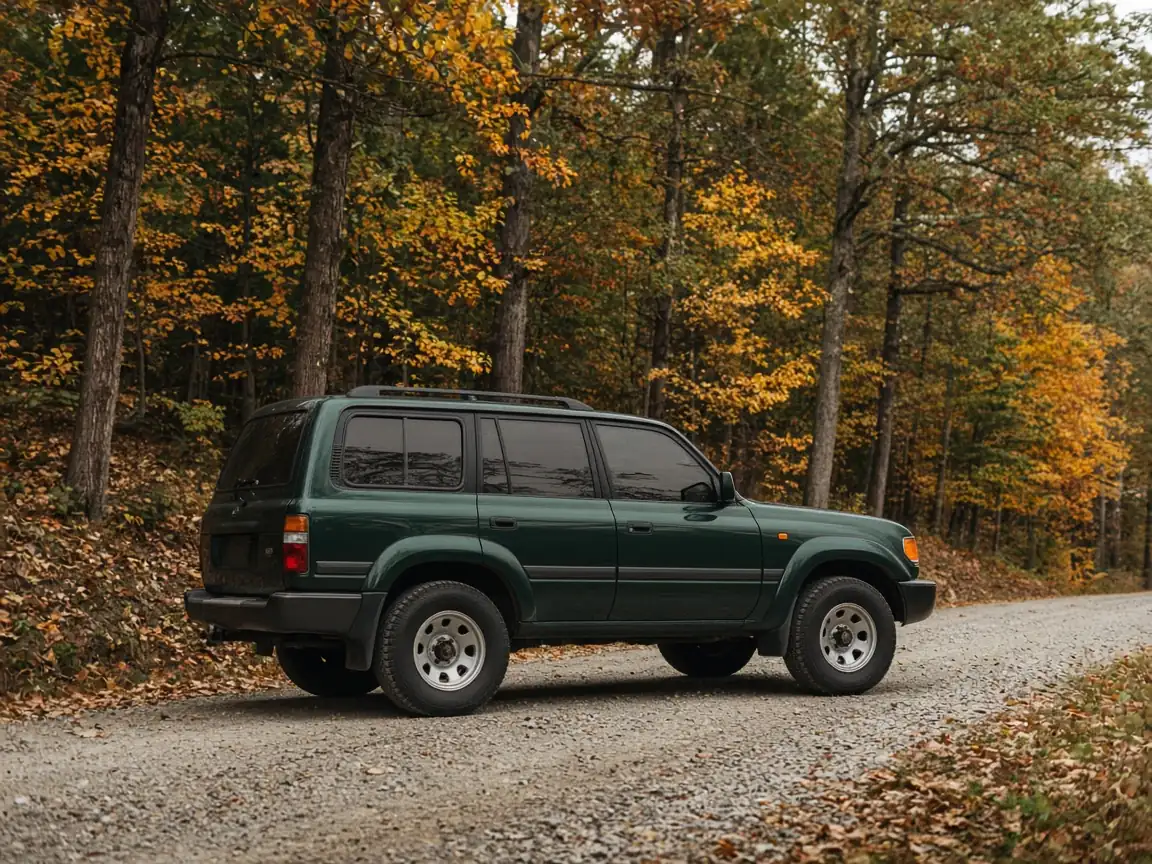
Produced from 1990 to the late 1990s, the 80 Series combined coil springs on solid axles front and rear with full-time four-wheel drive and a far more comfortable cabin. Optional factory front and rear locking differentials make it formidable off road. For many enthusiasts it is the high point of the classic Land Cruiser line. See our 80 Series buyer’s guide before you buy one.
The 100 Series
Arriving in 1998, the 100 Series moved most models to independent front suspension with torsion bars and, in many markets, a V8 petrol engine. It is more refined and more comfortable on the road. Some markets also received the 105, which kept a solid front axle and is prized by off-road travellers.
The order that makes sense
Most people buy accessories in the order they appear in photographs: bull bar, lights, roof rack, then everything else. A more sensible order is to start with the parts that affect safety and capability, then add protection, recovery and storage. Each step informs the next. You cannot choose the right springs until you know what weight you will carry, and you cannot judge the weight until you know what you are carrying.
- Tyres
- Suspension, chosen for the final weight
- Recovery equipment
- Protection: bull bar, underbody guards and rock sliders
- Lighting
- Storage, roof racks and camping equipment
- Power: dual battery systems
1. Tyres: the most important upgrade
Factory highway tyres are the biggest limitation on most Land Cruisers off road. A good all-terrain tyre in a load rating suited to your weight dramatically improves grip on dirt, gravel, mud and snow, and is more resistant to punctures. Stick close to the original diameter or go only modestly larger. Larger tyres change the effective gearing, can rub at full articulation and may require re-gearing the differentials to restore performance.
The BFGoodrich All-Terrain T/A KO2 remains a dependable benchmark for this kind of vehicle, with strong sidewalls and predictable behaviour on wet roads.
2. Suspension: choose for the final weight
Once you know roughly what your fully loaded Land Cruiser will weigh, choose springs and shocks to match. Too soft and the vehicle sags and wallows; too stiff and it rides harshly when unladen. The aim is correct ride height and control at your typical load, with a modest lift of around two inches being plenty for almost everyone.
For the 70 and 80 Series, the established choice is Old Man Emu’s load-rated spring and shock kits, which have decades of development behind them on these exact vehicles. For the independent-front 100 Series, matched torsion bars and dampers are the equivalent upgrade. Avoid cranking the torsion bars to gain lift; it reduces ride quality and wheel travel.
3. Recovery equipment
If you go off road, you will eventually get stuck, and a Land Cruiser’s weight makes self-recovery essential. The basics are rated recovery points front and rear, a snatch strap or kinetic rope, rated soft shackles, a tyre deflator and compressor, and recovery boards. A winch is the next step for those who travel alone or in very difficult terrain.
We recommend MAXTRAX recovery boards as the single most useful recovery item, and a Warn winch if you mount one on a winch-compatible bar. Learn to use any winch safely before you need it.
4. Protection
A good bull bar protects the radiator and front structure from animal strikes and provides a mounting for a winch, lights and antennas. Choose one designed for your exact model so the airbag sensors, where fitted, still work correctly and the cooling airflow is not obstructed. ARB’s Deluxe bull bars are built for exactly this and are widely available for all three series.
Underbody protection, including steering and sump guards, matters more if you drive rocky trails. Rock sliders protect the sills and double as a step. Remember that every piece of steel adds weight; aluminium options exist for some parts.
5. Lighting
Modern LED driving lights are dramatically better than the halogen units of the 1990s, and a well-aimed pair improves safety at night on rural roads. Upgrading the headlight bulbs or reflectors within legal limits is worthwhile too. Avoid large, glaring light bars that dazzle other road users and attract unwanted attention.
6. Storage and roof racks
A Land Cruiser’s roof is a tempting place to put everything, but weight up high hurts stability. Use the roof for bulky, light items: a tent, an awning, empty jerry cans or recovery boards. Keep heavy items low and forward of the rear axle where possible.
A low-profile flat platform is more versatile than an old-style basket. Front Runner’s Slimline II racks are a good choice for the 70, 80 and 100 Series, with model-specific mounting. Inside, drawer systems keep tools and recovery gear organised and secure; always secure heavy items so they cannot move in a crash. For tents and fridges, see our overlanding essentials guide.
7. Power systems
A dual battery system with a DC-DC charger allows you to run a fridge and lights without draining the starting battery. Modern lithium batteries are lighter and more tolerant of deep discharge, but make sure your charging system is designed for them. A solar panel or blanket extends your time off grid.
What to skip
- Huge lift kits: they raise the centre of gravity, stress components and rarely improve real-world capability.
- Heavy steel everything: weight is the enemy of handling, braking, fuel consumption and axle life.
- Cheap recovery gear: unrated shackles and straps can fail violently.
- Roof-mounted heavy loads: respect your roof’s dynamic load rating.
Series-specific tips
70 Series
Leaf-sprung rear ends benefit from quality spring packs with appropriate load ratings. Check the payload of your exact variant, especially single-cab utes and troop carriers carrying canopies or campers.
80 Series
Before accessorising, make sure the front knuckles, wheel bearings and lockers are serviced. Fresh bushes and an OME kit transform the vehicle.
100 Series
Check the independent front suspension components, including ball joints and CV boots, before adding a bull bar and winch. Consider uprated front torsion bars if you add significant weight up front.
For model history and specifications, see the Land Cruiser page. To find bumpers, lighting, racks and more, browse Land Cruiser parts or send us a custom request. Restoring an older 40 Series instead? Start with our FJ40 restoration guide.
Related