Buying guide
The best years to buy a Land Cruiser, Defender or G-Wagon (and the years to avoid)
The best model years to buy a classic Toyota Land Cruiser, Land Rover Defender or Mercedes G-Wagon, the years that need extra care, and why condition…
The legends
Engineered for the military, built in Austria, adopted by the world: the classic W460 and W463.
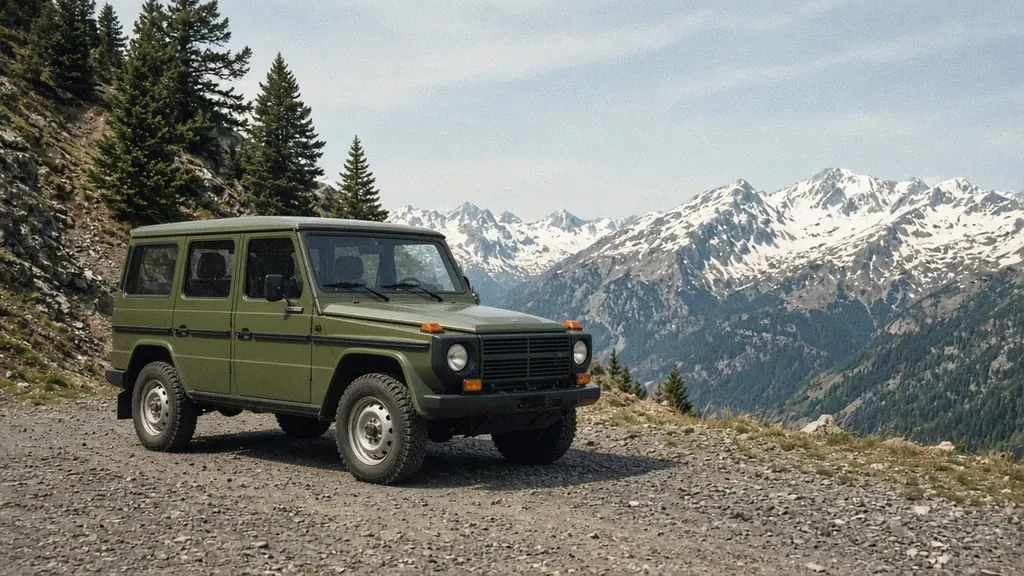
In the early 1970s, Daimler-Benz and the Austrian firm Steyr-Daimler-Puch began developing a new cross-country vehicle, originally with military customers in mind. The result, the Geländewagen (“off-road vehicle”), went on sale in 1979 as the W460. It was built in Graz, Austria, and in some markets was sold under the Puch name.
The G was engineered without compromise: a stiff ladder frame, solid axles with coil springs, and, as it developed, locking differentials front, centre and rear. Military forces around the world adopted it. In 1990 the W463 added permanent four-wheel drive and a far more luxurious interior, beginning the G-Class’s transformation into one of the most recognisable luxury vehicles on earth, while keeping its formidable off-road hardware.
Daimler-Benz and Steyr-Daimler-Puch agree to develop a cross-country vehicle together.
The W460 goes on sale in short- and long-wheelbase forms, with open and closed bodies.
A specially adapted G serves as a papal vehicle during a visit to Germany.
Front and rear differential locks become standard on the W460.
The W463 arrives with permanent four-wheel drive, three locking differentials and a luxury interior.
The utilitarian W461 continues the working-vehicle line for military and commercial buyers.
V8 and later V12 engines turn the W463 into a high-performance luxury icon.
A comprehensively redesigned G-Class is introduced, ending the classic W463’s long run.
| W460 (e.g. 300GD) | W463 (e.g. G 500) | |
|---|---|---|
| Production | 1979–early 1990s | 1990–2018 |
| Typical engines | 2.3 L and 2.8 L petrol; 2.4 L and 3.0 L diesel | Inline six, V8 and V12 petrol; six-cylinder diesels |
| Four-wheel drive | Selectable, two-speed transfer | Permanent, two-speed transfer |
| Locking differentials | Front and rear (standard from 1985) | Front, centre and rear |
| Wheelbase | about 2,400 mm (SWB) / 2,850 mm (LWB) | about 2,400 mm (SWB) / 2,850 mm (LWB) |
| Built in | Graz, Austria | Graz, Austria |
The G-Wagon matters because it is proof that a vehicle can be engineered for the most extreme conditions and remain relevant for decades with only evolutionary change. Its basic shape and architecture survived nearly forty years. The three locking differentials, solid axles and stiff frame give it off-road credentials few vehicles can match, while its build quality and presence made it a luxury symbol.
For classic owners, the W460 offers mechanical simplicity and pure utility; the W463 offers comfort and performance. Both demand careful inspection, and both reward owners who respect their engineering when choosing custom G-Wagon parts.
From the journal
Buying guide
The best model years to buy a classic Toyota Land Cruiser, Land Rover Defender or Mercedes G-Wagon, the years that need extra care, and why condition…
Buying guide
The top 10 upgrades for a classic Land Cruiser, Land Rover Defender and Mercedes G-Wagon, ranked by real-world value: suspension, tyres, rust…
Buying guide
Custom G-Wagon parts that genuinely improve a classic W460 or W463, and the ones that don’t: suspension, tyres, roof racks, lighting, interiors and…